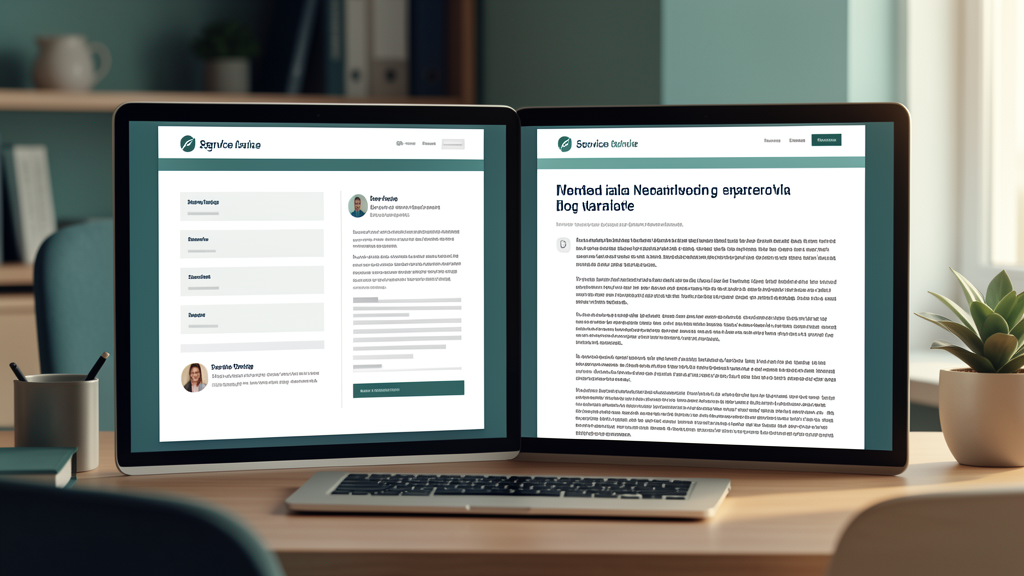
Service pages vs blog posts is a question of search intent, not a contest between "commercial" and "educational" content. A service page helps a patient who is ready to understand and book the care your practice provides. A blog post answers a narrower question that patient may have before, during, or after that decision. Getting this right matters for SEO because a service page and a blog post are built, structured, and measured differently — and publishing the wrong format for a given keyword produces a page that satisfies neither Google nor the patient.
Practices that treat every topic the same way — usually by defaulting to blog posts because they are easier to batch-produce — often end up with a thin or missing service page sitting behind a stack of articles that can never fully replace it. A 2,000-word blog post about "migraine treatment options" cannot compensate for the absence of an actual migraine treatment service page when a patient is trying to find a provider near them and book an appointment. This guide walks through how to tell the two formats apart, what belongs in each, and how a small practice should sequence its publishing so the foundation gets built before the content library grows around it.
What is the job of a medical service page?
A medical service page exists to describe care the practice actually provides and to move a ready patient toward booking. It should explain who may benefit from the service, common reasons a patient would seek an evaluation, what the process actually involves from first visit to follow-up, where the service is offered, which clinician provides it, and — critically — how to request an appointment.
The page needs to align with decision-stage intent. Real searches for medical services often combine several elements at once: a service name, a specialty, a physician type, and a location, such as "pediatric dermatologist eczema Austin." Practical details matter here just as much as educational depth. A patient this close to booking does not want to hunt for your phone number or insurance list buried three paragraphs into a general explainer.
As a general rule, one strong, comprehensive page per priority service outperforms several near-duplicate pages built around slightly different keyword variations. Splitting a service across multiple thin pages to chase synonyms tends to dilute relevance rather than multiply it, and it creates internal competition for the same search intent.
What is the job of a medical blog post?
A blog post exists to answer a focused patient question, explain a concept, compare options carefully, or provide preparation and follow-up guidance. Its job is different from a service page's: it can attract people earlier in their journey, before they have decided they need care, and it can demonstrate the practice's expertise on a specific topic in a way a service page's practical format does not allow.
A useful article should still point somewhere. That next step might be a link to the relevant service page, a link to another educational resource, or plain guidance about when an in-person evaluation is appropriate — but it should never attempt to diagnose the reader or replace a clinical visit. The most effective educational content treats itself as one step in a longer patient journey rather than a standalone destination.
Accuracy, clear authorship, readability, and genuinely answering the question asked are what separate a blog post that ranks and earns trust from one that reads as generic filler. Practices that publish thin, interchangeable articles solely to hit a schedule tend to see weaker engagement and weaker rankings than those that commit to fewer, more substantive posts.
How do you match the format to search intent?
Use a service page when the searcher appears to want a provider, a procedure, an evaluation, a location, or a way to book an appointment. Use a blog post when the searcher wants an explanation, a list, a comparison, a preparation guide, or a general answer to a question that is not yet about choosing a specific practice.
Consider two examples. "Migraine specialist in Austin" clearly belongs to a service or location page — the searcher already knows what they need and is looking for a provider. "What should I track before a migraine appointment?" fits a blog post — the searcher is preparing, not yet choosing. A broader query like "migraine treatment" may require careful review of the current search results, because the intent behind it can be genuinely mixed between informational and commercial.
Do not decide the format from keyword wording alone. Look at what Google is currently showing for that query and think about the action the patient most likely needs to take next. If the results are dominated by clinic and provider listings, that is a strong signal the intent is commercial. If they are dominated by explainer articles and comparison content, informational content is likely the better fit.
What should a small practice publish first?
Sequencing matters more than volume, especially for a practice just getting its content program off the ground. A recommended order looks like this:
- Accurate home, contact, physician, and location pages — the foundational trust and navigation layer.
- A focused page for each priority service the practice actually offers.
- Essential practical pages covering insurance, referrals, medical records, accessibility, and appointment logistics.
- Supporting patient-education blog posts that answer real questions tied to those services.
- Broader thought leadership content, once the conversion path from search to appointment is already working.
A practice that jumps straight to step four or five without solidifying the first three is building an attractive front porch on a house with no foundation. A medical website content checklist is a useful tool for auditing whether that foundation is actually in place before investing further in a blog.
Should service pages and blog posts link to each other?
Yes — contextual internal links are what make the two formats work together instead of competing. A service page can link out to preparation guides, risk and expectation explainers, and related condition guides for patients who want more detail before booking. A blog post, in turn, should link back to the relevant service using natural, descriptive language such as "learn about our migraine evaluation process" rather than a bare "click here."
Avoid inserting the same aggressive booking link into every single paragraph of an educational article — it reads as pushy and can undercut the trust the article is trying to build. A thoughtful internal linking strategy for medical sites treats each link as a genuine next step for the reader, not a repeated sales pitch.
How much content actually belongs on a service page?
There is no magic word count for a service page — the right amount of content is whatever is needed to answer the decision the patient is trying to make, no more and no less. A complete page typically includes a clear overview, who may benefit, the evaluation process, the treatment or service components involved, the physician who provides it, the location, practical logistics, a short FAQ section, and an obvious next step.
Resist the urge to turn a service page into an encyclopedia entry. If a topic deserves deep detail — the biology of a condition, an exhaustive list of treatment alternatives, a long recovery timeline — link out to a focused article rather than burying the page's primary action under paragraphs of tangential explanation. Keep the call to book or contact the practice visible, and make sure the page is easy to scan on a phone, since a large share of medical searches happen on mobile.
Why does keyword cannibalization happen, and how do you prevent it?
Keyword cannibalization happens when two or more pages on the same site compete for the same search intent, splitting ranking signals between them instead of consolidating authority on one clear destination. The fix starts with assigning one primary keyword and one primary intent to every URL, and maintaining a simple content map that tracks page type, target query, service, location, and which page is considered canonical for that topic.
When you discover two pages that genuinely overlap, decide deliberately which one should lead. Merge the useful material from the weaker page into the stronger one, redirect the retired URL when appropriate, and update internal links so they all point to the surviving page. A service page and a blog post can coexist perfectly well on the same general topic — the key is that their intent is genuinely different, not just their wording.
What belongs in the SEO package for each format?
Both service pages and blog posts need a unique SEO title, a concise slug, a meta description, a clear H1, a focus keyword, descriptive image alt text, relevant internal links, and credible external sources where claims are made. Use Article schema for blog posts, and the appropriate combination of page, organization, physician, or medical clinic schema for service pages.
If you use Rank Math or a similar SEO plugin, it will typically look for the focus keyword in the title, the meta description, the URL, the opening content, the body, and at least one subheading. Treat that as a useful checklist rather than a target to game — forcing repetitive, unnatural keyword placement to satisfy a scoring tool tends to hurt readability without meaningfully helping rankings.
How should you measure performance for each format?
Service pages should be evaluated primarily by qualified phone calls, appointment requests, online bookings, completed visits, and local search visibility — the metrics that reflect whether the page is actually converting ready patients. Blog posts deserve a broader set of measures: informational keyword rankings, assisted conversion journeys, movement in internal link clicks, external citations, and the service interest they generate downstream.
Do not expect every educational article to produce an appointment on its first visit from a reader. Its real job may simply be to answer a question well enough that the reader feels informed and comfortable enough to book later — sometimes weeks or months after first reading it. Judging a blog post purely by immediate conversions misses most of the value it actually provides over time.